
Two foams, matched to the job
Spray Foam Insulation in Lancaster, PA
Which foam goes where, how thick, and why, all on paper before work starts.
- Free on-site estimates
- Written quote with material, depth and R-value per area
- Moisture and air leaks checked before anything is covered
Spray Foam, Chosen Spot by Spot
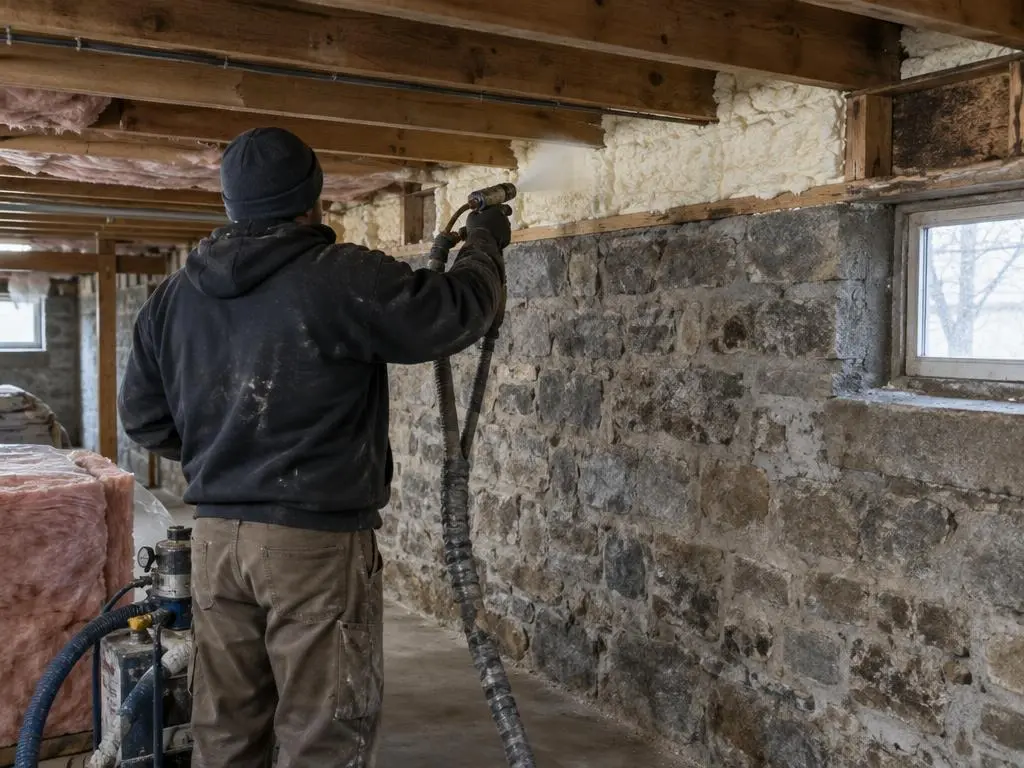
Spray foam insulation starts as two liquids mixed at the gun. Sprayed onto framing, concrete or steel, it expands and cures into a solid layer that insulates and stops air in one pass. In Lancaster County we use it where that combination matters most: rim joists and foundation walls in basements, roof decks over finished attics and cathedral ceilings, open walls during remodels, and the steel walls and roofs of shops and pole barns.
Closed-cell
Closed-cell foam is dense and hard, with HomeGuide listing R-5 to R-7 per inch at about $3.00 to $5.00 per square foot installed. At typical thickness it works as a vapor retarder, and it does not soak up water. That makes it the default for anything touching concrete, stone or steel, and for roof decks with no space for venting. It also stiffens the framing it bonds to.
Open-cell
Open-cell foam is soft and expands a great deal, so it fills awkward cavities around pipes and wires. HomeGuide puts it at R-3.5 to R-3.7 per inch and $1.50 to $3.50 per square foot. It is an excellent air barrier and quiets sound between rooms. Because it lets some vapor pass, we use it in the right assemblies: interior partitions, above-grade walls with a proper vapor control layer, and some roof lines where the design accounts for moisture.
Old houses need extra thought
Lancaster's stone and brick houses were built to dry through their walls. Spraying foam directly on old masonry can trap moisture that used to escape and lead to damage in freeze-thaw weather. In those houses we focus foam on the rim joist and framed areas and leave solid masonry alone, or use methods that let it dry. We explain the reasoning before you decide.
Fire protection and re-entry
Foam in living spaces and many attics and crawl spaces needs a thermal or ignition barrier, depending on the location and the product's listing. We include that in the plan. During spraying the area is closed off and ventilated, and HomeGuide advises staying out for at least 24 hours.
Want foam and blown-in priced side by side? Ask. Get a free estimate
What This Covers
The places we spray most in Lancaster County buildings, and the foam we usually choose.
Rim joists and sills
Closed-cell around the basement perimeter, where framing meets foundation.
Basement walls
Closed-cell on poured or block walls before finishing, when they are dry.
Roof decks
Closed-cell or open-cell under the roof in finished attics and cathedral ceilings.
Open walls
Foam in exposed stud bays during remodels and additions.
Pole barns and shops
Closed-cell on steel walls and roofs to insulate and stop dripping.
Floors over garages
Closed-cell under rooms above unheated space.
Published Spray Foam Insulation Costs
| Job | Range and source |
|---|---|
| Spray foam, installed | $1.50 to $5.00 per sq ft (HomeGuide) |
| Open-cell / closed-cell | $1.50 to $3.50 / $3.00 to $5.00 per sq ft (HomeGuide) |
| About 1,000 sq ft | $1,500 to $5,000 (HomeGuide); $3,150 to $7,500 existing home (Fixr) |
| Existing walls / new construction | $3.15 to $7.50 / $2.75 to $6.50 per sq ft (Fixr) |
| All exterior walls | $4,000 to $10,000 (HomeGuide) |
| Whole house | $8,000 to $20,000 (HomeGuide); $10,000 to $30,000 (Fixr) |
| Typical job minimum | $1,000 to $2,000+ (HomeGuide) |
Ranges from HomeGuide (2026) and Fixr (2025), national, not local. Thickness, foam type, access and prep change the total, and small jobs often carry a minimum. The written estimate we give you is what you pay.
How It Works
1. Walk-through
We see each space, check for moisture, wiring and leaks, and measure.
2. Written foam plan
Foam type, thickness, R-value and price for each area, with alternatives where they fit.
3. Prep and protect
Masking, covering and ventilation set up.
4. Spray
Foam applied in passes to the stated thickness.
5. Finish
Trim, check thickness, clean up, and give the re-entry time.

Why Choose Us for Spray Foam Insulation
Foam where it fits
We say when another method is better.
Masonry respected
No foam traps moisture in old stone or brick.
Thickness on paper
Inches and R-value listed for each area.
Spray Foam Insulation Questions
Closed cell vs open cell: which should I use?
Closed-cell for anything near moisture, concrete, steel or tight framing. Open-cell for interior and above-grade cavities where cost and sound matter more. Many projects use both.
Can spray foam go on old stone basement walls?
Sometimes, if the wall is dry and the plan lets it dry another way. Often we foam only the rim joist above and leave the stone. We decide case by case.
Does spray foam add strength to walls?
Closed-cell foam adds some racking strength to the framing it bonds to. Open-cell does not.
How thick is the foam?
It depends on the R-value needed and the space available. The quote states the inches and resulting R-value for every area.
Is spray foam safe once cured?
After it cures and the re-entry period passes, it is an inert solid. We follow the product's ventilation and re-entry instructions.

Spray Foam Insulation Service Areas
- Spray Foam Insulation in Lancaster, PA
- Spray Foam Insulation in Manheim Township, PA
- Spray Foam Insulation in Lititz, PA
- Spray Foam Insulation in Ephrata, PA
- Spray Foam Insulation in Millersville, PA
- Spray Foam Insulation in Willow Street, PA
- Spray Foam Insulation in East Hempfield, PA
- Spray Foam Insulation in Mount Joy, PA
- Spray Foam Insulation in Elizabethtown, PA
- Spray Foam Insulation in Columbia, PA
- Spray Foam Insulation in Strasburg, PA
- Spray Foam Insulation in New Holland, PA
- Spray Foam Insulation in Leola, PA
- Spray Foam Insulation in Manheim, PA
Get a Spray Foam Insulation Estimate
Tell us the spaces and what you have noticed. We will look and send a written foam plan.